What do we mean by dynamic resource scheduling?

When we all started working in the housing sector over 15 years ago, there was little choice when it came to Dynamic Resource Scheduling, Opti-Time (later becoming DRS) was the de facto solution and we focused on processes such as ‘job at a time’ and ‘managing the emerging day’.
Within the wider Field Service sector there has always been a larger choice of scheduling systems, many with route optimisation and algorithms suitable for particular sectors such as fleet optimisation, logistics, and delivery services.
As time has moved on, the term Dynamic Resource Scheduling has become a catch all for anything that happens to have some type of automated allocation of jobs to resources, irrespective of how dynamic it really is.
One of the key elements is the reactiveness of the system, not only should it be able to optimise jobs initially, but it should be able to react to each and every change to the schedule in real time.
The reactive scheduling should be automatic and not require the need to set off any form of batch schedule.
It should always involve a global optimisation across all relevant resources and not just optimise single diaries or single shifts. This is something the majority of suppliers can’t do.
It should be able to offer globally optimised appointments at the first point of contact, it should book into an appointment slot immediately optimised and not optimise afterwards.
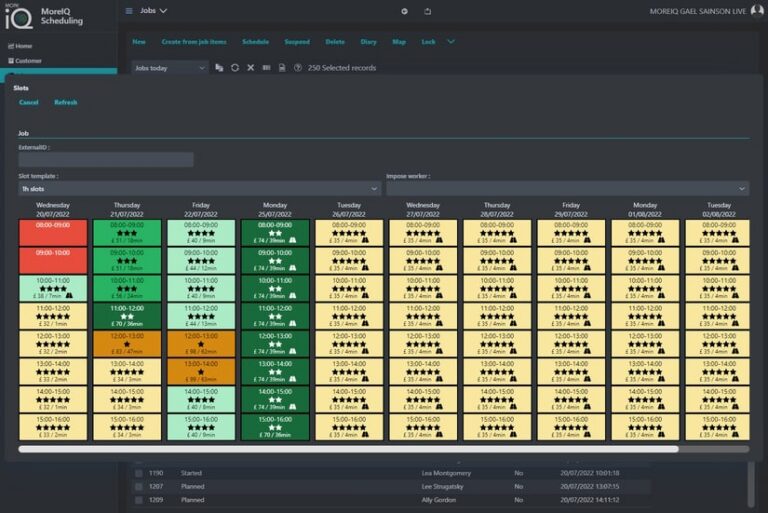
Optimised booking screen showing the booking cost for each possible slot after optimisation. This screen allows us to negotiate the best booking with the real cost impact for each slot.
Allow for bulk scheduling and optimisation of jobs along with single appointments.
Cope with complex constraints such as dependencies, recurring jobs and multi-day jobs.
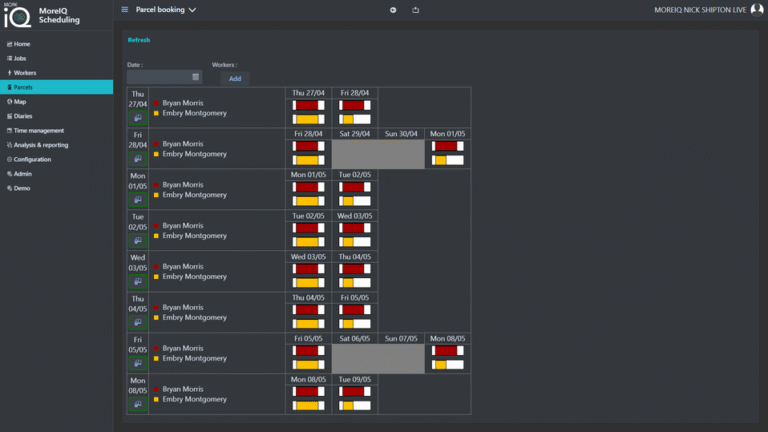
Multi-day, multi technicians booking showing all the possibilities at different possible dates.
Have a powerful background optimisation that is continually fine tuning the schedule.
Allow multiple configurations for dispatching jobs, including job at a time and dispatching a whole day.
Base the scheduling on cost based optimisation not just travel time.
Have flexible configuration options to allow you to be in control, not just be a bare algorithm.